September 23, 2026 · Updated September 24 · 12 min read
OpenClaw × Jev × local decision modelsOpenClaw + Jev:
agents get a decision layer.
OpenClaw now has a native role for fast, typed judgments. Jev is one provider; local models are part of the design. Here is what that changes for real agents—and one product flow already built on top.
What did OpenClaw actually announce?
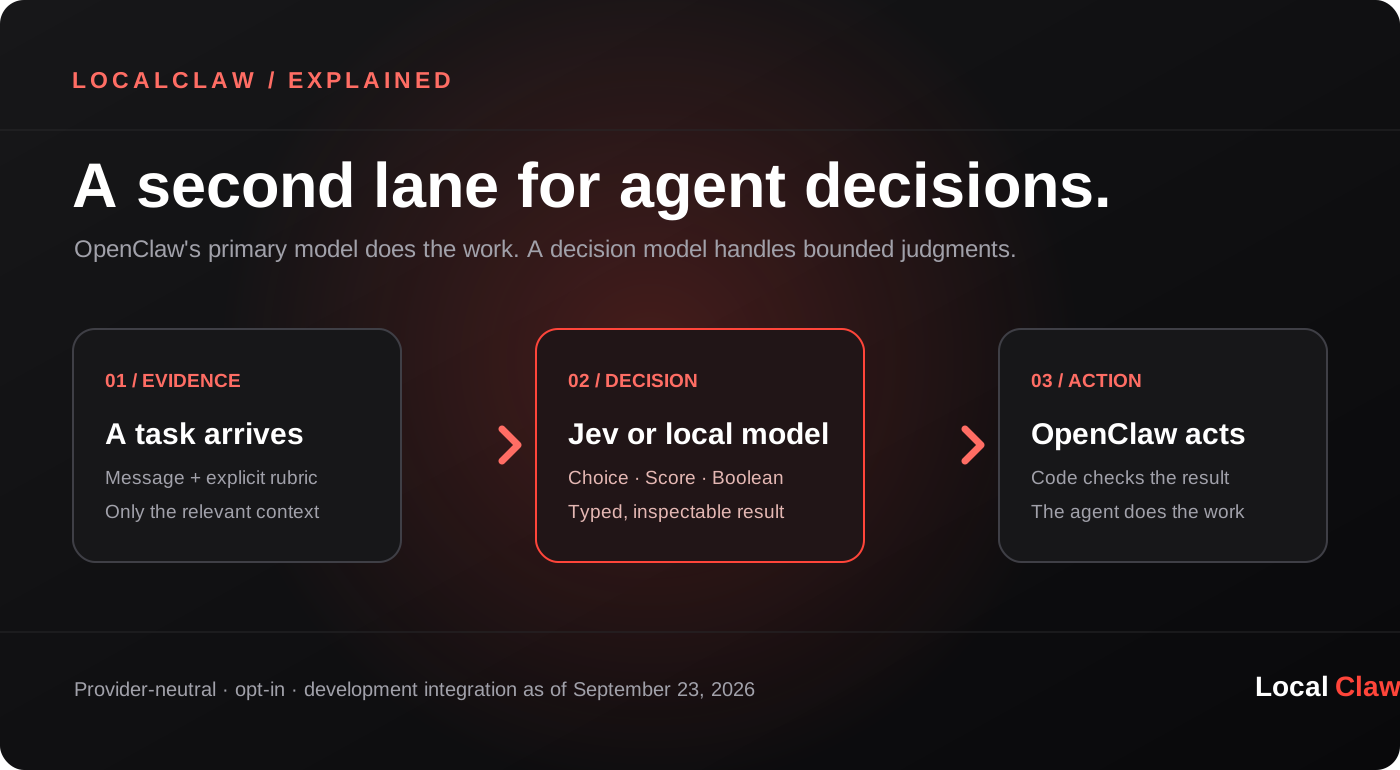
OpenClaw is introducing decisionModel as a separate model role with a shared evaluation API. Developers can ask a configured model to choose among options, score an ordered rubric, or estimate the probability of a yes/no condition. Jev, made by TypeSafe AI, is supported through a separate adapter. The main chat model remains responsible for conversation and agent work.
The important shift is where those calls can happen. A plugin can invoke api.runtime.decisions.evaluate directly from its code; a configured agent can use the core decision_evaluate tool when allowed. The call returns a typed result that ordinary software can inspect. OpenClaw no longer needs every small judgment to become another open-ended conversation with the primary model.
Sources: OpenClaw announcement · OpenClaw's explanation · Decision-model documentation.
One agent. Two very different kinds of work.
An agent answering “Help me fix this failed checkout” may need a full conversational model to investigate logs, use tools and explain the repair. Before that work starts, the application may only need to classify the message as an outage, a billing issue or a routine question. The second question has a small answer space and a defined output shape.
plus a clear rubric
Choice · Score · Boolean
Chat model handles the full task
Imagine the state “Checkout is failing for all customers.” A single request could ask which team should handle it, how severe the disruption is, and whether human incident response is needed. The result might contain a named route, a fractional urgency score and a Boolean probability, each with model provenance. Those are illustrative output types, not measured Jev answers.
The shared interface matters because the same plugin can call the configured decision role without carrying a separate provider SDK and credential path for every model. A user can choose a provider per agent. An empty per-agent override turns decisions off for that agent; there is no automatic fallback to the chat model.
Source: OpenClaw's API contract and examples.
Three answers software can use immediately.
Pick a route
Given named alternatives, return one choice and estimated probabilities for the supplied labels. Example: support, billing or sales.
Place it on a scale
Use ordered descriptions such as no disruption, one workflow blocked and widespread outage. The result may fall between rubric positions.
Estimate a condition
Return probabilityTrue for a defined yes/no question. TypeSafe's primitive is called Noul; OpenClaw exposes it as Boolean.
These are predictions, not proofs. A 0.9 result does not establish that nine out of ten such cases are correct in your environment. A Score of 2.5 is a position on the rubric, not “85% confidence.” OpenClaw preserves reported estimates rather than silently rewriting them.
Good rubrics need an honest exit. If a message could fit none of the named Choice options, add an “insufficient evidence” route or send uncertain results for review. Every Choice answer competes with the alternatives you supplied.
The biggest gains may be the decisions users never see.
OpenClaw's announcement focuses on small judgments that accumulate across an agent's day. These are promising places to experiment, not a list of automatic features already shipped.
Know when to stay quiet
Before a bot interrupts a busy Discord thread, a decision model could judge whether anyone is addressing it. OpenClaw describes this as a concrete community problem. Less unwanted speech would make the agent easier to live with.
Show the right capabilities
Filter a long tool or skill catalog to the few entries relevant to the current task. The primary model could spend less context and deliberation on unrelated capabilities. This is a proposed use case, not a measured speedup.
Keep useful history
During compaction or search, a narrow judgment could identify which messages are likely to matter. The test is whether the resulting agent solves the task better, not merely whether its prompt is shorter.
Match the model to the job
A bounded classifier could route simple work to a cheaper model and complex work to a stronger one. That pays off only if the extra call plus the selected model improves total cost, latency and error rate.
Support triage is another clean example: classify the destination, score urgency and flag a possible incident in one bounded request. This makes sense outside chat because application code can consume the typed answers without parsing prose. The business rule that opens an incident, sends a message or refunds money remains separate.
Source: OpenClaw's proposed use cases.
A platform capability is bigger than one clever plugin.
Josh Lehman's first Jev experiment exposed Jev as a tool for the agent. It worked, but the primary language model had to think about when to call that fast tool. Calling a decision model directly from a plugin hook or another owned operation changes where the judgment sits. It can run before the expensive conversational step.
One model role
OpenClaw configures decisions separately from the primary and utility models. Users can choose a provider for a particular agent.
One typed API
Plugin authors call the shared Decision runtime. A provider adapter translates that request to Jev, Kev or another backend.
One action policy
Application code checks the result and decides whether to continue, ask for review or use an existing fallback. A model estimate never grants permission by itself.
That architecture is more durable than wiring Jev into every plugin. It makes hosted and local providers a real user choice. Different backends still have different accuracy, calibration, latency and hardware requirements; a common API does not erase those differences.
Hosted Jev, local Kev, local ONNX: follow the data.
The provider-neutral design matters to people who care where inference runs. Hosted Jev sends the selected evidence to TypeSafe and incurs its usage charges. OpenClaw's TypeSafe adapter can instead point at a separately running local System One server such as Kev. A different ONNX plugin offers local CPU classifiers. They share a role, not identical model weights or quality.
| Option | Where inference runs | What you need | What to understand |
|---|---|---|---|
| Jev via TypeSafe | TypeSafe-hosted endpoint | Compatible host, separate plugin, protected credential | Selected evidence leaves your machine; provider usage is billed. |
| Kev via TypeSafe adapter | Your separately running local server | Kev checkpoint and explicit loopback URL | OpenClaw does not download weights or start the server for you. |
| ONNX classifiers | Local CPU subprocess | Separate ONNX plugin and a downloaded or exported model | A classifier is not interchangeable with Jev on every judgment. |
OpenClaw's TypeSafe guide recommends starting with a Qwen3-based Kev-4B checkpoint on a Mac and documents Apple Silicon support. This is a technical setup path, not evidence that Jev itself has become a downloadable local model. The ONNX option offers smaller CPU classifiers but requires model preparation and quality checks.
LocalClaw explains the wider landscape in our visual guide to Jev, Nimble and Laya. Those research projects are separate from the official OpenClaw providers described here. For the main agent model, our OpenClaw setup guide covers local inference with LM Studio or Ollama.
Sources: Official TypeSafe adapter guide · Official ONNX plugin guide.
What can you use today?
OpenClaw 2026.9.6 shipped the optional Decision Model role. The separate TypeSafe package supports hosted Jev and a local Kev server; the separate ONNX package provides local CPU classifiers. Both require a compatible OpenClaw and plugin API, and neither is enabled automatically.
Explicit evaluation
Configured agents can receive the core decision_evaluate tool, subject to tool policy. Plugin code can call the shared Decision runtime.
Automatic product behavior
Selecting a Decision Model does not by itself route chats or optimize every interaction. A plugin or product still defines when to evaluate and what policy consumes the result.
LocalClaw's Routed Chat beta is one such consumer: it calls a local ONNX Decision Model, applies a conservative three-way routing policy and requests the mapped chat model for each turn.
Sources: OpenClaw 2026.9.6 release notes · Decision Models · TypeSafe plugin · ONNX plugin.
Measure the whole agent, not the fastest model call.
A fast decision is useful only when it improves the workflow after its own network, queueing or local inference cost is included. Build a labeled set of actual decisions. Include ambiguous messages, negation, missing facts, misleading instructions, mixed issues and cases where none of the supplied options fits.
How often is the branch right?
Measure routing accuracy, false escalation, missed escalation and calibration on representative cases. Check the agent's final task result, too.
Does the whole path improve?
Compare total task latency and spend with a baseline that has no decision call. Include retries, model switches and review work.
What happens on failure?
Define what unavailable, low-confidence or malformed results do. Keep approvals, access rules and publication authority outside model predictions.
A decision result is evidence for a policy. It does not authorize a shell command, a payment, a message to another person or publication. OpenClaw explicitly keeps normal tool policies and approvals in force. It rejects unsupported requests instead of quietly truncating or splitting them; callers decide how to handle an unavailable result.
For a local setup, privacy gains depend on the chosen endpoint and the entire workflow. Hosted Jev is a remote call; Kev and ONNX inference can stay local after setup, but downloads and other tools may still contact outside services. Record the provider and model used for each evaluation so later comparisons are reproducible.
Source: OpenClaw decision results, errors and action boundaries.
OpenClaw + Jev FAQ
Is Jev available for stable OpenClaw?
Yes. OpenClaw 2026.9.6 added the Decision Model role, and the separate TypeSafe package is available for compatible hosts. It remains optional and disabled by default.
Will Jev replace my OpenClaw chat model?
No. OpenClaw selects a decision model separately. It supplies typed judgments to explicit evaluations and supported consumers, while the conversational model continues the agent's main work.
Does adding a decision model automatically make OpenClaw faster?
No. The current experimental assistance setting has no automatic consumers attached, and every evaluation has a cost. Test an actual workflow against its existing path.
Can OpenClaw decision models run entirely on my computer?
There are local provider paths: a separately operated Kev server through the TypeSafe adapter, and ONNX CPU classifiers through the ONNX plugin. Hosted Jev itself sends selected evidence to TypeSafe.
Are Jev's probabilities safe to use as automatic approval?
No. They are estimates to evaluate on your own data. OpenClaw says decision results do not grant permission to send messages, publish content or change durable state.
The interesting part starts after the announcement.
A new place for intelligence inside the workflow.
OpenClaw now has a standard place for bounded judgments between incoming evidence and the agent's next step. Jev makes the idea vivid; the provider-neutral role makes it useful beyond one vendor. The best outcome is an agent that chooses better tools, keeps better context and knows when to stay quiet—without asking its main model to deliberate over every small fork.
The next milestone is measured, opt-in consumers. A shipped model role is infrastructure; product value appears when a workflow uses it transparently, handles uncertainty and improves a real user's task.
Explore LocalClaw Labs' browser decision experiments to see the shape of a bounded judgment. Labs uses standard open-model baselines, not Jev or a verified OpenClaw decision provider.
Compare Jev with local decision models →Primary sources and methodology
- OpenClaw announcement on X and OpenClaw's September 22 article for the rationale and proposed use cases.
- OpenClaw's decision-model documentation for the role, API, tool, limits and release status.
- TypeSafe adapter documentation for Jev, Kev, credentials and packaging state.
- ONNX plugin documentation for the local CPU alternative and requirements.
Sources checked September 24, 2026. Diagrams and example decisions are explanatory. LocalClaw did not benchmark hosted Jev for this article.